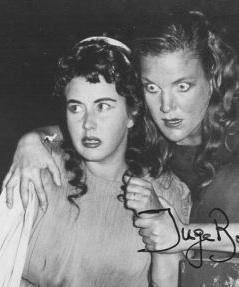
I'd be remiss if I didn't say a few words about Grey Gardens, now in previews after its wildly successful off-Broadway run. Wildly successful, if you ask me, less on account of its overall shallowly fanciful, occasionally inspired score than the jaw-dropping performances of its two leads.
Yes, I had doubts when I heard they were making a musical of Grey Gardens. Actually, that's not right. Doubts imply mixed feelings. I just thought it was the worst idea I'd ever heard. I began to imagine musical numbers with chorus lines of big dancing racoons waving slices of white bread, and wake up screaming. Because really the choices seemed to be either: go for broke/insane; or just lift the entire text, for lack of better term, from the movie and through-compose it into a nightmarish epic.
Well, the creators had an idea I had not, which is why they're writing musicals and I'm typing whatI think of them for an audience of seven. They filled in the backstory, much alluded to in the film, giving Christine Ebersole a chance to pull of one of those Broadway coups everyone likes, playing first Big Edie in the 40's and then Little Edie to the B.E. of Mary Louise Wilson in 1973.
You know, the first time I saw the film Grey Gardens, I was so bored I couldn't make it through. It's certainly grown on me, though I'm not a full-fledge fanatic. But yeah, I get that they're utterly fascinating personalities...Little Edie famously notes how hard it's getting to drawn the line between the past and the future, all the while straddling the line between batshit crazy and eccentric in a way I'm not sure society allows anymore.
Through vocal mimicry of the most modulated, lived-in sort and a kind of physicality most opera singers never learn, Ms. Ebersole and Ms. Wilson channel exactly that quality, and it's tremendous theater. The supporting cast is quite capable in roles that feel a bit half-imagined, maybe 3/4, best of all/most of all Bob Stillman as Big Edie's accompanist/royal subject of fag haggery George Gould Strong. The role is a throwback, not in a good way--it features (but seriously) a joke where Big Edie says she's been looking for flowers for a party but there's not a single Pansy from here to East Hampton or something. I'll let you fill in the punchline. But Stillman makes much of little.
This Rigoletto on Sirius, by the by, is pretty wonderful. Tucker in nice form, Gueden, Warren, and my peculiar fixation, Jean Madiera. Hopefully they'll replay it and you can listen if you're a subscriber and fond of Verdi. I don't make any money from them, honest, I am just enjoying the fuck out of the broadcasts. Hurrah! Um, so anyway...
The songs, save for two melancholic little gems to close each act, are not awful. They're just not special. They suffer in comparison, say, to the deft, deadpan wonderfulness of the writing in The Drowsy Chaperone. The songs from Grey Gardens are 90% less likely to get enjoyably lodged in your cranium. And one or two, like the "Jerry Likes My Corn" number are pretty perplexing. Still, if I were you [and, consequently, not sitting here typing out this duller than dishwater review] I'd at least consider going, and make sure to dream up the right costume for the day.
Saturday, October 21, 2006


Thursday, October 19, 2006
I tried SO hard not to
I mean, not to be a dick or anything, but for the record the "Enzo Adorato" phrase ended on a perfectly comfortable A natural.
I'm trying to figure out why I feel compelled to point this out. I feel like one of the hellish, barn-bred Domingo bashers on rec.music.opera back in the day who couldn't leave people's liking for their singer alone. It's just...I admit the flaws of the singers I love--I'm sure I'm going to be irritatingly enraptured by Podles' Azucena next summer, but I'm equally sure she's not going to reach the climactic notes with much grace-- and without trying to tear down anyone's idols, it does seem fair to point out the claylike substance in the sandals when it's all getting up around my neck a little.
Anyway I had to run out on an adventure involving domestic violence, the Kartvelian language family, and walnuts so I missed all but the first hour of the broadcast. By all accounts Madame Millo sang the rest of the night with an easier top and her, uh, usual gusto.
Wednesday, October 18, 2006

Sunday, October 15, 2006
A Weekend of Non-operatic Kulcher
Let's see if I can even write about A Chorus Line, shall we? I knew every word of it years before I was obsessing about who's the perfect Woglinde [Schwarzkopf. Glad you asked], so it's kind of like trying to draw the back of your eyelids. I saw the original run as it was limping toward the grave in 1989, but before that my parents had been playing the original cast album on car trips for as long as I can remember. Another good reason not to review it: the original cast is so tightly wound around my aural synapses, it's hard not to react in that infurating way, judging performers by their likeness to the Platonic ideals.
So I tried just to hear it with new ears, and it's been long enough since those car trips with the ol' cassette playing, I think maybe it worked. And on those terms, the revival is a real success, though I'd love to hear it settle into something even better. Almost everyone onstage is a double threat, with a triple here and there. Charlotte d'Amboise as the ostensibly most three dimensional and for me, the least interesting character, Cassie, for the most part knocks it out of the park, though her vocal production feels weird to me, seems like she's about to bust a chord. I think my favorite though was Natalie Cortez (I just googled, hope that's her name) as Morales. She does, yeah, sound a bit like Priscilla Lopez, so YMMV, if anyone still says that. But she sings on the words, which the rest of the cast does to varying degrees. And yeah, the horrific 70's gay shame monologue of Paul the Tragic Queen, whereafter he is to all intents and purposes snuffed plotwise, made me cry. What can you do?
The weekend's other excursion, with Mama D'Annato, was to this year's Capote biopic, Infamous. The film begins promisingly enough with a strange, wonderful scene of Gwyneth Paltrow as Peggy Lee, either having a little breakdown onstage or putting on a riveting performance of one. GP can sing, by the way. And then she has her breakdown and so does the movie. The movie purports to be based on George Plimpton's fascinatingly curated volume on Capote, a bunch of written records of oral history. The movie starts out lunging in this direction with some fake documentary interviews with the likes of Gore Vidal and Diana Vreeland. These are awkward. Holy mackerel, are they awkward. And they set the tone that this is going to be a movie about imitation rather than interpretation as was the much, much more succesful Capote with Phillip Seymour Hoffman. To this end, they have cast an actor who looks shockingly like Capote, certainly moreso than the decidedly un-waify, strangely handsome Hoffman. Before you ask, I do realize I'm probably in the minority in finding him hot, yeah.
It's an incredibly difficult way to do a movie like this, and the film fails rather starkly. And so it goes in other directions as well, including a daring, sort of embarassing go at pure speculation involving TC's relationship with Perry Smith. Um and this is the part where I return to the draft of my review and am still a tiny bit drunk from this benenfit thingy but want to turn out an entry, so my review is going to die an untimely death. Go see Infamous and tell me I'm not nuts, that it's really incredibly clumsy. And wins this month's award for bad southern accent on film, though I won't say who because she's really kind of endearing.
Thursday, October 12, 2006
There's Always Room for Gioconda Lore
Reader* Flying Diva writes:
*I sort of hate this "Reader Flying Diva" business because it seems condescending..."Enthralled follower of my glorious pen," etc., but I can't very well say "Faithful correspondent" since I had never heard from Mr. or Ms. Diva before.
Mad as I am for Dimitrova, I couldn't resist passing along a delightful story.
Another Obituary of Sorts
Reader, I mean correspondent, I mean person-who-is-reading, I hope you have been appraised of the closing of Tower Records if you live in the New York City area. More to the point I hope you have been appraised of it but aren't going to go snap up the things I want. I have an odd history with Tower--just after college, I actually worked there, for minimum wage, for a little while. Nasty people to work for. But I also used to go there every trip to New York before I moved there, knowing I'd find things I couldn't get at home. Maybe I could have ordered them online but there's something about having it all arrayed before you that can only dredge up the awful cliche of a Kid in a Candy Store.
Blah blah, vaseline the lens, insert fond memories of rushing to tower after a late performance, crazy things I found there, I'm being dismissive because in point of fact when I walked into the one on lower Broadway and saw the "Going out of Business" signs, I felt (cross my heart and kiss my elbow) like crying. It's hard to explain. I think the key fact is that until now when I went in there, because I'm not a bazillionaire, I'd look at forty things and say, "I'll maybe get it later" and then walk out with some laserlight crap "Mado Robin sings Disney" bullshit that fits my budget better. And then, if you'll excuse the materialism, I'd dream of the ridiculously priced Keilberth Siegfried I left behind until one day I found it on sale for whatever one third of ridiculous is and decide to sacrifice the cat's college money. Now there is no later. I imagine there are recordings I simply won't find again.
I have no idea what I'm going on about. It feels a little like that dire prediction of many years about the classical record biz going belly up on us is a little bit coming true. itunes is still hideously understocked for opera, and besides, itunes is becoming creepily proprietary and universal in a troubling Googlean way. Listen, I'm going back to 33's, if not 78's. It has been pointed out to me by One Who Knows that of all musical recording media, the oldest ones hold up best if you look at it one way--78's sound exactly as they did in 1945, whereas CD's I bought last week won't play. So I'm throwing the battle, as far as technology goes. If you need me, I'll be in the corner with my Brunswick suitcase model.
Oh p.s. I got my Dalibor. It was the last copy. Sorry!
...I write to confirm the comment Zinka made about the b-flat. She made it on a public radio program called "The Vocal Scene" during an interview with the host, George Jellinek. I nearly fell out of my chair laughing in disbelief. I figured that I had heard this incorrectly. A few years later, they reran that episode and, sure enough, that's what she said.
However, my favorite Zinka moment was the one I had the privilege to witness. In the mid 80s, Queler and OONY did a Gioconda with Ghena Dimitrova. Although she later sang some decent performances at the MET, this performance was definitely NOT one of her triumphs. After the performance, where she had been booed a bit, I noticed Zinka standing on 7th Ave. just below 57th St......waiting for her ride? As was her way, she stood larger than life, in a white coat, signing autographs. As I got mine, one of the "faithful" said to her, "Ooh, Mme. Milanov......no one could EVER forget YOUR Gioconda!!" She seemed to grow another few inches as she steeled herself and smilingly replied, "ESPECIALLY after tonight!!!"
*I sort of hate this "Reader Flying Diva" business because it seems condescending..."Enthralled follower of my glorious pen," etc., but I can't very well say "Faithful correspondent" since I had never heard from Mr. or Ms. Diva before.
Mad as I am for Dimitrova, I couldn't resist passing along a delightful story.
Another Obituary of Sorts
Reader, I mean correspondent, I mean person-who-is-reading, I hope you have been appraised of the closing of Tower Records if you live in the New York City area. More to the point I hope you have been appraised of it but aren't going to go snap up the things I want. I have an odd history with Tower--just after college, I actually worked there, for minimum wage, for a little while. Nasty people to work for. But I also used to go there every trip to New York before I moved there, knowing I'd find things I couldn't get at home. Maybe I could have ordered them online but there's something about having it all arrayed before you that can only dredge up the awful cliche of a Kid in a Candy Store.
Blah blah, vaseline the lens, insert fond memories of rushing to tower after a late performance, crazy things I found there, I'm being dismissive because in point of fact when I walked into the one on lower Broadway and saw the "Going out of Business" signs, I felt (cross my heart and kiss my elbow) like crying. It's hard to explain. I think the key fact is that until now when I went in there, because I'm not a bazillionaire, I'd look at forty things and say, "I'll maybe get it later" and then walk out with some laserlight crap "Mado Robin sings Disney" bullshit that fits my budget better. And then, if you'll excuse the materialism, I'd dream of the ridiculously priced Keilberth Siegfried I left behind until one day I found it on sale for whatever one third of ridiculous is and decide to sacrifice the cat's college money. Now there is no later. I imagine there are recordings I simply won't find again.
I have no idea what I'm going on about. It feels a little like that dire prediction of many years about the classical record biz going belly up on us is a little bit coming true. itunes is still hideously understocked for opera, and besides, itunes is becoming creepily proprietary and universal in a troubling Googlean way. Listen, I'm going back to 33's, if not 78's. It has been pointed out to me by One Who Knows that of all musical recording media, the oldest ones hold up best if you look at it one way--78's sound exactly as they did in 1945, whereas CD's I bought last week won't play. So I'm throwing the battle, as far as technology goes. If you need me, I'll be in the corner with my Brunswick suitcase model.
Oh p.s. I got my Dalibor. It was the last copy. Sorry!
Saturday, October 07, 2006
In the Flesh
I sort of already wrote up Faust, so just a few comments now, since on the whole, I agree with me.
Much to my surprise, I think I'd take this cast over the one that opened the production, though that may be mainly about Soile Isokoski and the newly wonderful Ruth Ann Swenson. I once had a brunch go very awkward over the fact that as Lucia, I found her utterly banal. (Doesn't that sound like I was having brunch with Ruth Ann Swensen? 'K, think that if you want.) Since then, her voice has settled into a warm, pliant thing though the last few notes are a little dire, and her acting has gone from nonexistent as I remember it to rather moving. It was always a substantial sound and remains so. Marguerite isn't really a money note role anyway as long as you sound solid in the trio.
If one were to look back over the last 15 years, can there be many singers who have been consistently so rewarding to hear as Ramon Vargas? No, I'm actually asking, or at least half asking. I have missed plenty of his work but every few years when I check in he's still such a class act. True, he didn't bowl me over in Romeo et Juliette but I don't think anyone would've. It's just not an opera I can deal with. As Faust he left nothing to be desired, vocally speaking. If he had better stage instincts, he'd be unquestionably a better choice than Alagna, who I adored in this role during the first run of the production. As it is, he's just a better singer. I heard him the morning of the performance on Sirius singing an equally lovely Alfredo to a pleasantly restrained Fleming. Personal to RV: can we be pals? Best Friends 4EVAR? Mejores amigos pa' siempre?
Tommi Hakala I missed on Sirius the other night, and he's really an interesting, not straightforward singer. I'm surprised to find by googling him that aside from being pretty cute, which is statistically very likely if you're Finnish, he's also apparently young. He doesn't sound it. The voice is kind of all over the place, most unruly. And he pours it out with a generosity that stands in contrast to all that caution that makes for long, dull careers. Jesus, he'd make a great Wozzeck, not least because his acting is (on the evidence of one performance) good and over the top.
Not much to add about Abdrazakov--still impressed. Still wondering about the bottom of his voice, but it's not a big deal. When you can hit it out of the park in the "et Satan conduit le bal" range, you can sell enough of the role that only the very sourest would throw a fach-fit.
A propos de rien, or is it just a propos rien?, Bernard Holland's review of Gioconda made me kinda happy.
p.s. Why is there no recording of Dalibor on itunes? What is the world coming to?
Thursday, October 05, 2006
The Prosecution Rests
Knock knock
Who's there?
Your posse of ballad-singer buddies carrying the chick who likes the guy you're after in a chemically induced death-resembling sleep.
You know your life is way crazier than the other girls at the office when your gang of street-singer friends shows up at the front door with the etc.
The question is: how does La Gioconda manage to be about an hour too long, feature the stupidest (but this time we mean it!) most verkakte libretto ever imagined, include a ditty we all know either as "Hello muddah" or "that commercial with the little puppy who can't quite sing the last line but has no more fleas" and still be one of the best times you can have without Ann Coulter and a pack of hungry lions?
In the case of The People vs. La Gioconda, here are the exhibits:
Exhibit A: (con) Seriously, I don't know about you guys, but I'm never sure where to go about getting a bottle of stuff that isn't poison, but looks like poison, but only knocks you out, and allows you to awake just when your rival in love who has decided to save you is about to be stabbed. Apparently in 17th century Venice, this was like getting a latte.
Exhibit B: (pro) The great thing about hiring a soprano who used to be a mezzo is she can get all chesty about the "fra le tenebre" and such. The great thing about that soprano being Violeta Urmana is that the fach reassignment surgery appears to be a done deal, no Frankenstein seams on the voice. I bet her Lady Macbeth would be a bitch on wheels, though after seeing her in La Gioconda--Italian for You're Joking--and Ariadne, it's hard to know if she's a stage animal or not. The former is a bit of a cartoon and the latter is too, only a grand and tragic cartoon. Neither one cries out for acting, per se.
Exhibit C: (con) The Dance of the Hours would be one thing if the opera weren't already (with intermissions) on a geological time frame.
Exhibit D: (pro) The Met has some excellent dancers on hand. Actually their ovation was louder than anyone else's, whatever the hell that's about. Perhaps Peter Gelb's next direction in pulling in audience should be to cancel the entire season and just put on Giselle and The Nutcracker and stuff. I jest. Where are those smelling salts? Does the vast majority of people secretly like ballet better than opera? I know I don't. But I digress from my original point which was that the dancers really were awfully poised and lovely to look at. That "I can spin around on my toe and my other leg won't touch the ground" trick becomes quite jaw-dropping after a point.
Exhibit E: (con) Plieting about on a 40 year old set, it probably goes without saying you're not going to bust out the newest moves, which suddenly makes me think of that horrible poseurish looking thing on the mailing from BAM where the swanned up Ballerina is flashing gang symbols. Shoot me. But just the same, with that much mothball-ready material onstage, I kept half hoping some mad auteur would swoop in and stage it instead with footage of Satanic rituals or whatever's hip in Berlin this season. A revisionist Gioconda: that would be comedy gold.
Exhibit F: (pro) the rest of the cast, for the most part. Point, game, match, and set. Once in a while I do get the faint sarcastic vibe form Borodina in stupidhead material, but I may be projecting. She certainly brings the loud. Say did anyone else hear she smokes? Because her voice sounds something like indestructible, in that Simionato way. While I do like a little element of nervousness and potential heartbreak in my singers, there's also something gratifying about a pair of brass cords, a voice built like a tank. Mishura, by the way, who didn't entirely impress as Amneris in one of the joyless Aidas of the last few years, was pretty much a peach as La Cieca. Didn't keep one from anticipating Podles, but you couldn't ask for much more in the chestage department, nor that of campy, just-in-case-you-forgot representations of blindness.
Machado sounds like a work in progress, but maaaybe an excellent work. He spent more of the evening tiptoeing than I'd have liked, but he's decametres if not furlongs ahead of the pack (Licitra, Farina...) in terms of tone and musicality. Lucic (I hate to lose his diacritics, as it's one of the fun features of Serbian that it has two distinct "ch" sounds. They're phonemic. Isn't that exciting?) barreled through the role of Barnaba but wasn't much fun in an awfully juicy villain role.
Exhibit G: Oh my god, the note. The note the note the note.* How could I not talk about the note? It made my eyes roll back in my head is all. She didn't do that "Am I still even singing?" trick--it was a plain old one-p piano, but it was shapely and ravishing.
I'd kind of like to say something statementy about Paata Burchuladze and the value of a well aged bear of a voice but I think he's just one of those singers I like because I like him.
Oh and p.s. the other reason Gioconda prevails despite its many laughable qualities is that nearly every bar is filled with operatic deliciousness. Maybe Urmana, whom I first heard in--no joke--a high school auditorium in Cicero, Illinois, billed as Violeta Urmanacitivus or something along those lines, can talk the Met in the interest of novelty into putting on I Lituani. That could only be a positive development.
*I wont be coy. In case you're not a Giocondaphile, The Note is a b flat that comes between the contralto's aria "Voce di donna" and the baritone/tenor duet "Enzo Grimaldo, Pricipe di Santa Fior." It's well set up to be a dazzler, and back in the day some Croatian lady named Kunc** whom I've never much cared for made it her calling card. "Pipple came for mine b flet," she is rumored to have said, "and vent home." Story courtesy of one Mr. JL, who may wish to remain nameless so we'll stick to initials.
**There I am being coy. Zinka Kunc, better known as Milanov.
Tuesday, October 03, 2006
I Caved
Currently listening to Sirius online. Need superglue to repair my one decent pair of headphones.
Very curious to hear how this Faust was from folks who were there. On air, it's 90% superb, though I came in very late. Swenson's weak on top (who could have foretold?) but so much more enjoyable in this rep than her old one; Abdrazakov: maybe weak on bottom? But to my delight, more willing/able to camp it up than the stately Pape, a vocal genius but a boring Mephistopheles.
Though the raging debates about Met announcers give me a headache--they're not conducting the damn thing--I will say I find Ms. Juntwait an agreeable companion at the opera.
I'm recalling, as the soldiers sing, how last time around we watched the parade of coffins onstage and could not help but think about how our government had forbidden us to see the coffins that would make the war a tragedy rather than a football rally. I think that was this scene.
And here's the serenade...sorry to liveblog...so far, so good, but will he fumble on the awkward har-har-har? Not in the least. This is so much more charming and involving than his mirthless duet with his wife at the Volpe Gala. Somewhere out there, a very young opera fan just asked, "Who's Volpe?" Well, probably not yet. Aright--by making the laugh really raucous, Abracadabrov avoided the issue of the last few yuks being probably unsingably low for him. That works for me, actually.
Someone sounds unpleasant right now but Faust is one of those operas I never make it to the end of, so I'm not entirely sure who it is.
Is Sirius going to transport us all back to 1980, crouching by the speaker of the radio with a tape recorder?
Well, this likely less than riveting play-by-play has just run up against my need to turn off the sonar and hang from the ceiling for a while. An earlier text message indicates to me that JSU will be blogging this fer real, so tune in. Meanwhile, Chalkenteros has tossed his tiara in the ring!
p.s. Goddammit. I stayed up to hear the trio.
Sunday, October 01, 2006
Die Tote Scrim
I was just thinking about that time I was blogging Mazeppa (and they say there are no original utterances!) and requested a new rule whereby I get a dollar for every minute the scrim is down during an opera production. Kind of a refund from the lyric muse or the universe more generally for making me experience my art as if through a giant pair of nylons--say what you will about my effete prose style; I was only in hose one ill advised Halloween and I did not wear them over my head. It just doesn't make for a good view. Actually in retrospect I wish I had known that Halloween to kindly phrased suggestions that I'm a little horsey looking in drag by saying the look I was going for was Simionato by way of Theda Bara. That would have made me seem cunning instead of just fugly.
Where the hell was I?
Scrims. Right. Well if I had made that particular financial arrangement with the right people I'd say drinks are on me, but it was only in my head. Like so much else, you will be thinking. There is in fact not a moment when the veil is lifted from City Opera's venerable and somewhat likeable production of Die Tote Stadt. Much beloved production, I should say. So I've heard, and I kind of get it. It's fanciful and has a point of view. It's also pretty liberal with the gouda, I must opine. It is of its era in the way Lincoln Center is; you kind of have to love it as a mother would. All the film footage is pretty while entirely ham-fisted, etc. And there's something about a scrim, beyond my visual testiness about the way it makes me feel removed from the experience, that seems to justify other vagueness. Like the way the production gets called Freudian in that meaningless way, and nobody says, "what exactly is Freudian about it?" Or the fact that that isn't a lute but a mandolin, I don't know.
It's a wonderful opera, and I'm glad to have gotten to see it, and I'm puzzled that the Met (unless this is my blunder-of-the-day) hasn't done it since Jeritza asked for it. Jonathan suggested Mattila might be wonderful as Marietta, and I agree.* Susan B. Anthony fell short ofwonderful, somewhere in the fine to good range. Does her voice remind anyone else a little of Behrens? Without the temperament, I'm afraid, but some of that interesting craggy quality around the edges that I do genuinely value in a time of many processed and homogenized sounding soprano voices. Dan Chamandy was about on par, warming up toward the end into quite a ballsy, indelicate sound. I think his could be a useful voice. Seriously, truly, I am not being cunty when I say he'd be outstanding in heldensqueak stuff like Mime. Weston Hurt was in fine form indeed until the went and shot him. (Other scrim issue: as in Mazeppa, there was a moment where he was supposed to appear, an apparition, with a bullet hole in his forehead, as if to announce that death is "Schlechter als die Hahnchen bei Kreskes." Yes, that's right, we here at My Favorite Intermissions occasionally crack idiotic inside jokes for the benefit of exactly one person. Anyway you could hardly see the deadly wound from our stage-near seats, so I'm guessing elsewhere it was invisible.)
On another level altogether there was the exciting debut (?) of Keith Phares. Shut up, I'm totally talking about his voice. Fine, yes, he's also dreamy. But even so, I'm sure I'm not hearing with my loins when I say his reading of Pierrot's Tanzlied was exemplary. I meant to tell you what he has coming up, only I can't for the life me find my program.
This is the problem with reviewing a couple of days later: things fade and disappear. I'm going to have to stop there, and feel my account is sketchy. Next up: as the Magic 8 ball used to say, ask again later. Maybe Gioconda. Here at the beginning of the season it's harder to go to opening nights because they're all kind of piled up and you'd have to quit your job. If you know any dowagers looking for an heir, I'll consider it, but barring dowagers, I gots to make the donuts. Time to look around the blogroll and see if there's much news of Gioconda or Idomeneo--though I'm waiting for the other cast for that one.
*my first asterisk of the season and surely not my last: we had a tougher time casting Paul. Klaus Florian Vogt perhaps?
current listening: Callas as Ifigenia in 1957. It's heaven, actually.
Tuesday, September 26, 2006
Butterfly Net
Ladies and Germs, Wellsung is back!
Here's the rest of the round-up, or some of it:
We're going to have to wait for a Parterre pan or paean, as JJ is doing it up for Gay City News, we presume.
JSU is opting for Idomeneo as a season kick-off but sent in a bulletin from Time's Square, as did our correspondent who actually treads the boards, singin'.
Alex Ross presents a few snapshots of the festival atmosphere on the plaza.
If I didn't link you, no slight is meant (well, I mean, with maybe one exception! Now where'd I put that I'm-just-joshin'-ya emoticon: ;) )
Only the fact that I'm moonlighting these days saved me from my suicidal, death-by-sleep-deprivation instinct to go to Gioconda tonight. I'm dying to see it.
Meanwhile I feel a little like weighing in on the Matter of Moppet v. Puppet. I'm pro-puppet, and it's not just because I think children onstage spell the end to any critical reception of a work of theater. [Remember those reports that Maria Ewing dragged her little mentally ill German love-child out with her for a Wozzeck curtain call because nobody can give a child anything but an enthusiastic reception?] I actually remember thinking during Being John Malkovich that I may have the issue with puppets that so many people have with clowns, so I wasn't pre-disposed to like it. In pratice, I think it works, primarily because it's so far removed from what you might imagine, a big floppy doll getting lugged around the stage. Two people work the puppet, so it has a...not exactly a realistic motion, but a subtle and stylized simulacrum. And honestly, it's probably less creepy to see a silent puppet up there than a silent child. Children are almost never silent for extended periods, quite the opposite. This is one reason Maury categorically avoids them.
And as long as I'm doing a kitchen sink entry: the quasi-new Cat Power album is fucking fantastic.
Monday, September 25, 2006
Yes
...and by that I mean just yes. Yes, you should go. And this despite many reservations, that in the end don't matter. I'd like to state for the record that I'm not an entirely jaded opera-goer. I love the Met most nights, even if the rep is conservative and they don't have a real Puccini soprano or Heldentenor to their name. But I do maintain that it's only every few or several seasons they have a production that comes from that place of absolute artistic certainty, you know the kind I mean? The last one I saw was Wernicke's Frau Ohne Schatten, until tonight. The latest now is very certainly Anthony Minghella's Madama Butterfly, consistently dazzling and intermittently devastating.
By the way, you know who can really wear a dress? Lee Radziwill! There she was, smoking her cigarette five feet from me. I mean, I wouldn't know her if she bit me, had to ask a paparazzo who the glamor gal was [embarassingly, but not really, I actually asked "Oh is thatLicia Albanese?" because I don't know what she looks like either and she's d'une certaine age and always at stuff.] But that's who it was, sewed into that thing and looking like a million and a half. Ten feet the other direction was Rufus Wainwright, and for fun I imagined he was utterly peeved that the flashbulbs weren't aimed at him. Everyone else was there too, but you've read about it. Kind of exciting. Very buzzy evening.
You're going to have to go, if you can, and you're going to have to do it despite some of the singing. In fact I may just write about that and not ruin any of the visual surprises, which is fine anyway considering my bumbling way with descriptions of the visual. It's pretty late, anyhow. For now: the colors are ravishing, the design is consistent with what I remember of Michael Levine's striking work in Carsen's Onegin, and the way characters make their entrances is quite enthralling. You'll never see a curtain call like this one again. Christina Gallardo-Domas could have sung a thoroughly mediocre Butterfly and gotten a screaming ovation, the way her curtain call is designed/choreographed.
Which is exactly what happened. Do you remember her Met broadcast debut? Because I do, in that way I remember Woody Allen movies from the late 90's and the last couple seasons of Melrose Place and things like that. They happened, and if I thought about it really hard, I could recall a few details beyond being unimpressed. So the question was: why have they picked her for this phenomenally well-hyped season opener in a new Met regime that's going to stir things up or die trying. I don't have an answer. By "tutu, piccolo, idiot" she had warmed up into a kind of plummy sound, and then she disemboweled herself so there wasn't much time to enjoy it. Up to that point, she was tentative and a bit squally with a tendency to lose support at very key moments. Um, yeah, like the last note of The One Aria Everyone Knows. And I guess we all have our unreasonable demands, and I guess one of mine is the c# in Butterfly's entrance. Not there, neither in the house nor in the video they were showing on the Panoperacon in the plaza with all the rehearsal footage. Anyway it kind of drives like a Puccini voice, but without meaning to be nasty, it really isn't one.
God, you know, Butterfly is kind of an awful opera, well not through and through but such banality next to such sublimity. And of corse the libretto, offensive from pretty much every vantage. Hell, even the culinary--do you know what's in milk punch? Half-and-half and bourbon, among other things. Who the hell drinks that? Then the humming chorus starts and I'm like any other sentimentalist, dabbing at my eye with a handkerchief embroidered with the likeness of Toti dal Monte.
New feature: you can get your Met Titles in German. I checked to see if they'd change Pinkerton to Linkerton but I guess that's dated or something. I think I'm putting off talking about Marcello Giordani because someone whose opinions I respect is a big fan and I just...my ear is tuned to find the basic quality of his voice a little tight and strangled. Ok, not a little. The bulk of it is gratifying, though, and he sings with fervor if not with abandon. I guess I don't have a better Butterfly cast in mind and, perhaps more to the point, I don't run an opera house. I'm not 100% clear on where it lies in terms of weight anyway, the role of Pinkerton. I think of it as spinto but I suppose Pavarooty went around singing it and wasn't it the definitively spinto territory of Don Carlo that he wiped out on? Ver. I think I promised way back when not to indulge in all that fach-alchemy. Next topic.
Dwayne Croft had a mixed night of it, if you ask me. I have been quite the fan at times, but the voice lacks a certain core I'm fairly certain it used to have. He had his moments last night, but nothing like the late 90's when there were equal parts ease and virility. Suzuki must be the role the word "thankless" was coined to describe, but Maria Zifchak made the big success, insofar as any Suzuki can. And since I don't care much for Butterfly itself I'm not going to weigh in on Levine's management of it, though it sounded fine and idiomatic to me. Someone else will know. The joy of being a minor opera blogger is you can defer and delegate.
The real hero, other than Meg Ryan of course, for getting into that little black dress, was Anthony Minghella. I'm not kidding, though: if all I can muster for the singing is this resounding "meh," you have to ask yourself why I'm so certain you'd like the production. I really can't imagine you wouldn't. Without a sassy sign-off, I'm just going to leave it there.
Wednesday, September 20, 2006
Meanwhile, across the plaza
Give me a medal. All night at NYCO's gala I somehow resisted the wicked temptation to channel Renata Scotto's creepy heckler and cry out "Brava, Metropolitan Opera!" I did.
As JSU has pointed out, it's a little bit of a drag to read a bullet-pointed round-up of these galas, so I'll forego that option and just tell you what you need to know. And the first thing you need to know is that Carol Vaness bears the most uncanny resemblance, in terms of the placement of her speaking voice and her speech cadences, to Shelly Long in the role of Diane Chambers on Cheers. I mean, that's pretty important, right? Also, she seems high.
For some reason it was about 45 minutes sitting in that there State Theater at yon gala for an opera company before anyone sang. There was an overture, and some speeches in which Madame Sills was sort of charming and Paul Kellogg made absolutely no attempt to sound like he was doing anything other than reading off a teleprompter. Which was huge and at the back of the house and you could turn around and see how closely he was sticking to the script. And then there was singing, and it was Carol Vaness and Vinson Cole and for some reason they chose Mozart. I'm sure they're very nice people. No, I kid. It was fine. Just...me, I'd steer clear of Mozart if I'd been singing much heavier stuff for 15 years. I know, I know: I said I like big clunky early music better than wheedly tinny early music. (We're counting the classical period.) But that's about style more than vocal estate.
Shit, it looks like I'm doing a run-down after all. I can never resist. I shall resist. Getting back to the Important Parts: the voices that excited me most were, hmm...James Valenti and Beth Clayton, I think. Valenti is a-fucking-nother young, handsome, very well schooled and promising tenor. He sang the Pearl Fishers duet with a baritone I couldn't hear so much because of stage positions. In twenty years when all these young things want to make some money, if they've kept themselves up, they will have The Ten Tenors concerts or something, in stadia. Seriously, I think we're now fixed for lyric tenors the way we were suddenly flooded with lyric mezzos in the late '90s. Without much effort, I can think of at least 8 I'd be happy to hear any evening or matinee.
Clayton sang in the Rosenkavalier trio/duet (d'you know, I realize we're all supposed to get all mopey about the trio, but I've always liked the duet better) and though she wasn't ideally positioned for me to hear her, I couldn't take my ears off her. I get the impression it's an imperfect voice and that she's the kind of unhomogenized singer that often wields that kind of voice. The kind that doesn't sound mass produced. Certainly she's a very striking figure, and I think she's also openly Sapphic, so hooray for that. If I figure out that I'm mixing her up with someone else, I'll edit like the wind. [ETA: tip of the hat to Gert, who informs me that Ms. Clayton and Patricia Racette are opera's newest love couple. Picture it: a marketing campaign like the Gheorghius got from their record label or like platonic pals/onstage amours Villatrebazonko currently enjoy. Yeah, not gonna happen.]
Vivica Genaux wins the Nadja Salerno-Sonnenberg Prize for bizarre facial movements during peformance, by the way. Either she's singing with an incredibly loose jaw or she's chewing her coloratura, but it's rivetingly weird to watch. Meanwhile, though, (as predicted) I liked her much better in Rossini than Handel. The Cenerentola rondo was a triumph. One strange details is that from time to time she'd back herself into breathing in the middle of a word, but mostly she sang bellows-in-the-back long phrases. Her ornamentation was way over the top, which is a valid choice.
Lots of jaw-wagging of the usual sort about how New York City Opera invented sliced bread went on. And a few unsubtle jabs at, well, the rest of the world for claiming NYCO-bred singers as their own. And then, like, Carol Vaness would suddenly be on body mic commenting on the greats she remembers singing with, and one couldn't help but notice that the list, well, it went something like this: June Anderson, Jerry Hadley, Rockwell Blake...I dunno, draw your own inferences. I'm being difficult, but I guess the facts as I see them from my somewhat ignorant perspective are: City Opera has had its moments of glory and a real golden age with Treigle and Sills, but let's not get loopy about it.
In keeping with my usual habit, I'm going to interrupt myself in the midst of a basically well-intentioned mocking of Carol Vaness to recall a performance of hers I wholly dug, that being Norma in Houston in the mid '90s (with Mentzer.) I wasn't a rabid bel canto enthsiast but I do remember finding her singing and stage comportment equally worthy of praise.
Oh, at one point they showed a film with Placido Domingo talking about how great City Opera was. It was a film because he couldn't be there that night. Or any other night since the 1960's.
There were also film clips from various productions over the years. The most enticing was Regina Resnik singing "Liaisons" from A Little Night Music. She forgot to read in the decrepit diva handbook where you're supposed to croak this particular song with leathery tone and approximate pitch, finessing the whole thing by virtue of age and attitude. If this exists as a whole, I'd love to see it.
What drove the crowd most vociferously bonkers was also my favorite item: Lauren Flanigan dressed in a rather outrageous get-up singing the sleepwalking scene from Macbeth with such delicious melodrama you'd think she was trying to remind the opera companies of North America of her existence. Listen, on dit that she's not the world's most pleasant colleague, and it seems like it miiiiight have something to do with her long absence from City Opera. Since I don't have to work with her, I wish to say: HIRE HER.
Saturday, September 16, 2006
My Date with Zeus: A Tell-All Memoir
I swear to god there's a review in here somewhere (he said, fumbling around in his prefrontal cortex.)
Why don't we just say this, as far as the production is concerned...We are talking of Semele, by the way, at The Little Company that Usually Could. So here's my grand pronouncement on the remarkaby consistent aesthetic they have going on in their Handel department: I get and am even grateful for the impulse to flood the stage with arresting, kookily lyrical tableaux. I guess I'd just be glad of a little less wink and a lot less nudge. But hang on. I've just stumbled upon a much more intelligible version of what I'm trying to say, so my unwitting guest columnist for the day is "boringwhitegirl" from the peanut gallery at Parterre. She wrote:
Personal to bwg: if you're mortified at being quoted, I'll cease and desist; I just decided I couldn't put it better.
You know, maybe this is just the illusion one has that the first time I saw something was the first time it was done, but I inevitably think back to Francisco Negrin's production of Partenope at Glimmerglass and it seems the whole routine was so much fresher back then: strip the thing of all the columns and overstated garb of antiquity, dress everyone well, dream up some striking, motivated but not obvious stage images, and call it an opera. Long about when the rose petals or whatever-they-weres started pouring through the roof of the bedroom on wheels, I lost my patience. Pretty, but so are a lot of things, and you have to choose which ones you put onstage or it comes apart at the seams, stops being theater.
Rant over, I guess. You'll want to know about the singing, and everyone succeeded on one level or another. Sanford Sylvan most of all, for me, but then I've always been a devoted fan, really from the moment I pulled the car over to dash into a building on the University of Texas campus, having just heard his Ungeduld from Mullerin on KMFA and called them on a pay phone (yes, little Sally, they were phones that stayed in one place and you put quarters in them) to ask who the singer was. His absolute evenness of tone has not left him, nor his aristocratic vocal bearing. I wish he'd sing Chou En Lai in one of these revivals, and I am still kind of kicking myself for missing his Wotan in EOS's scaled down ringlet.
Genaux has gotten heaps of good press in the last five years or so but I'd never heard her in house, just on some baroque album full of marvellously long lines. I'm not sure why I was merely pleased and not blown away...she's not missing much on any checklist, and "Iris, hence away" approached the spectacular. Maybe she just wasn't quite what I thought she was going to be and I had some trouble adjustin. One did hear the name Horne bandied about when people were discussing Genaux, and she's really more about an impeccable baroque line and less about gutsy aural machismo. I like her, no doubt about it. I think I'll like her more later.
Robert Breault I was surprisingly into, considering the voice is rather more Mascagni than Messiah. The deal is lately I'm so not invested in HIP or period performance, whatever the kids are calling it, that unless it's supremely well done, I'd just as soon hear something else entirely. Not for nothing my new favorite Monteverdi Orfeo (as opposed to my old favorite which was none, because I could never get into it much) is the one from La Scala in the 1930's. It's not the most florid part, as Handel goes, and someone like Kurt Streit would be twiddling his vocal cords the whole time. "Wherever you Walk" (with its lyrics that always strike me as funny, calling to mind some frightened soul being followed around by a crowd of tip-toeing Dutch elms) came out downright virile. I'm all for that. I guess it's time to lay my hands on that ridiculous old Hercules where Corelli put on thick soled boots so he'd be taller than Jerome Hines. Or isn't there--no joke--a Poppea with Gwyneth Jones?
I have this hunch they must have cut some/lots of Matthew White's music. My ear is a little out of practice with countertenors, I think. The palette can be a bit more narrow and you listen for other things. But he was certainly capable and stylistically on point. Not such a rich sound as we've gotten spoiled on by Daniels and Mehta, and not wildly inventive with phrasing, but then it's hardly the world's best role.
It's going to be hard for me to be very fair about Futral, honestly. Since Handel is so much not my bread and butter, I must have kind of imprinted hard on the first singer who made Handel sound fascinating to me, and everyone is judged by her likeness to Lisa Saffer. Elizabeth Futral's voice is in the same range of color, but baroque music sounds a bit like vocal tourism for her. A good deal of the music was finely sung, but it lacked that last layer of finish. God knows the breakneck pace of her final aria was a feat, a real accomplishment, but it also involved some fioratorical fudgding, and her high notes pop out of the line a little too much. I'm sorry I missed her Daphne. It just feels so far across the plaza some seasons.
So nu, my shaynkeits and meeskeits, the seasons just about to bust wide open, and I'm going to be honest with you: I'm buying the hype hook, line, and [system failure on sports metaphor.] I'm stoked. And unless James Gandolfini has any objections, I'll be writing about opening night when next I post.
Things I left out and am adding later, lazily not bothering to integrate:
1) Props to Pat Collins on the lighting, but for heaven's sake get a strobe light that doesn't make bug zapper noises if you're going to use one.
2) Um, oh yeah, everyone was dressed as Marilyn Monroe and Jackie O and stuff. I guess that's more or less the defining feature of the production. To what can we attribute my complete failure to mention this? Denial, most likely. Everyone looked great, but see above. These directorial ideas that seem great at first, does anyone think them through to the end of the opera? Because Marilyn Monroe, for instance, didn't die because Kennedy came to her in his godly form, or at least I assume not. (I wasn't there.) Really not trying to be picayune, just...
Why don't we just say this, as far as the production is concerned...We are talking of Semele, by the way, at The Little Company that Usually Could. So here's my grand pronouncement on the remarkaby consistent aesthetic they have going on in their Handel department: I get and am even grateful for the impulse to flood the stage with arresting, kookily lyrical tableaux. I guess I'd just be glad of a little less wink and a lot less nudge. But hang on. I've just stumbled upon a much more intelligible version of what I'm trying to say, so my unwitting guest columnist for the day is "boringwhitegirl" from the peanut gallery at Parterre. She wrote:
...for every one great bit of stage busines...there are 3 or 4 meaningless bits that seem to have no purpose except to distract you from the fact that, no matter what you do, they're going to take that damned da capo again.
Personal to bwg: if you're mortified at being quoted, I'll cease and desist; I just decided I couldn't put it better.
You know, maybe this is just the illusion one has that the first time I saw something was the first time it was done, but I inevitably think back to Francisco Negrin's production of Partenope at Glimmerglass and it seems the whole routine was so much fresher back then: strip the thing of all the columns and overstated garb of antiquity, dress everyone well, dream up some striking, motivated but not obvious stage images, and call it an opera. Long about when the rose petals or whatever-they-weres started pouring through the roof of the bedroom on wheels, I lost my patience. Pretty, but so are a lot of things, and you have to choose which ones you put onstage or it comes apart at the seams, stops being theater.
Rant over, I guess. You'll want to know about the singing, and everyone succeeded on one level or another. Sanford Sylvan most of all, for me, but then I've always been a devoted fan, really from the moment I pulled the car over to dash into a building on the University of Texas campus, having just heard his Ungeduld from Mullerin on KMFA and called them on a pay phone (yes, little Sally, they were phones that stayed in one place and you put quarters in them) to ask who the singer was. His absolute evenness of tone has not left him, nor his aristocratic vocal bearing. I wish he'd sing Chou En Lai in one of these revivals, and I am still kind of kicking myself for missing his Wotan in EOS's scaled down ringlet.
Genaux has gotten heaps of good press in the last five years or so but I'd never heard her in house, just on some baroque album full of marvellously long lines. I'm not sure why I was merely pleased and not blown away...she's not missing much on any checklist, and "Iris, hence away" approached the spectacular. Maybe she just wasn't quite what I thought she was going to be and I had some trouble adjustin. One did hear the name Horne bandied about when people were discussing Genaux, and she's really more about an impeccable baroque line and less about gutsy aural machismo. I like her, no doubt about it. I think I'll like her more later.
Robert Breault I was surprisingly into, considering the voice is rather more Mascagni than Messiah. The deal is lately I'm so not invested in HIP or period performance, whatever the kids are calling it, that unless it's supremely well done, I'd just as soon hear something else entirely. Not for nothing my new favorite Monteverdi Orfeo (as opposed to my old favorite which was none, because I could never get into it much) is the one from La Scala in the 1930's. It's not the most florid part, as Handel goes, and someone like Kurt Streit would be twiddling his vocal cords the whole time. "Wherever you Walk" (with its lyrics that always strike me as funny, calling to mind some frightened soul being followed around by a crowd of tip-toeing Dutch elms) came out downright virile. I'm all for that. I guess it's time to lay my hands on that ridiculous old Hercules where Corelli put on thick soled boots so he'd be taller than Jerome Hines. Or isn't there--no joke--a Poppea with Gwyneth Jones?
I have this hunch they must have cut some/lots of Matthew White's music. My ear is a little out of practice with countertenors, I think. The palette can be a bit more narrow and you listen for other things. But he was certainly capable and stylistically on point. Not such a rich sound as we've gotten spoiled on by Daniels and Mehta, and not wildly inventive with phrasing, but then it's hardly the world's best role.
It's going to be hard for me to be very fair about Futral, honestly. Since Handel is so much not my bread and butter, I must have kind of imprinted hard on the first singer who made Handel sound fascinating to me, and everyone is judged by her likeness to Lisa Saffer. Elizabeth Futral's voice is in the same range of color, but baroque music sounds a bit like vocal tourism for her. A good deal of the music was finely sung, but it lacked that last layer of finish. God knows the breakneck pace of her final aria was a feat, a real accomplishment, but it also involved some fioratorical fudgding, and her high notes pop out of the line a little too much. I'm sorry I missed her Daphne. It just feels so far across the plaza some seasons.
So nu, my shaynkeits and meeskeits, the seasons just about to bust wide open, and I'm going to be honest with you: I'm buying the hype hook, line, and [system failure on sports metaphor.] I'm stoked. And unless James Gandolfini has any objections, I'll be writing about opening night when next I post.
Things I left out and am adding later, lazily not bothering to integrate:
1) Props to Pat Collins on the lighting, but for heaven's sake get a strobe light that doesn't make bug zapper noises if you're going to use one.
2) Um, oh yeah, everyone was dressed as Marilyn Monroe and Jackie O and stuff. I guess that's more or less the defining feature of the production. To what can we attribute my complete failure to mention this? Denial, most likely. Everyone looked great, but see above. These directorial ideas that seem great at first, does anyone think them through to the end of the opera? Because Marilyn Monroe, for instance, didn't die because Kennedy came to her in his godly form, or at least I assume not. (I wasn't there.) Really not trying to be picayune, just...
Thursday, September 07, 2006
This is what Christmas Eve is like for goyim, right?
Can't resist joining in the fun of speculating/making wish lists about what they'll release. The central theme of my broadcastlust is Steber--I just took a stroll around the ol' database and she was in quite a lot of broadcasts, and I don't think that many of them are things I've seen even on Naxos or Bensar. Otello in '52 with Vinay and Warren? I'd take that. Wozzeck? Lay it on me.
Out of curiosity I'd love to hear Traubel in The Man Without a Country. It's kind of a stand-in fantasy for The King's Henchmen, which was too early for broadcasts. (Don't ask me why the one subs for the other...American operas that fizzled but featured a big star, I guess. King's Henchmen had Tibbett, and a libretto by Millay, by the way.)
There's some Thill including a partial Faust with Rethberg, and a Boris G that's probably not in Russian despite the presence of Kipnis--it's 1943 after all. And that one has Thorborg.
And of course there are some things with pet singers of mine, El Amor Brujo among other things with Jean Madeira, at least a couple of 'casts with John Alexander (unless it's another Alexander)and so on and so forth.
Met Maniac's Lost Broadcasts page features some partially extant broadcasts that are the stuff of dreams, some largely irretrievable Leider and Melchoir, zum Beispiel.
Wednesday, September 06, 2006
In which the vaults are opened
Yegods. Read the Times. Trust me, you'll know which article. I feel quite faint.
Later edit, under the rubric of "Maury's really good at finding the dark cloud behind the silver lining": I have to admit it's been fun having to hunt for Met broadcast recordings. And maybe am a tiny bit preemptively nostalgic about the days (i.e. now) when it's a big deal that I have some of the stuff I do. I remember finding the Corelli/Farrell Gioconda at the used record store in Denton, Texas and feeling like I'd really scored. I drove back to Dallas with the adrenaline rush of transporting contraband. (Had to be the opera. Dallas does not so much provoke reactions of happiness, and I say this as a loyal Texan, loyal despite everything.) So while I'm delirious with joy thinking about some of the 40's and 50's bounty perhaps soon to be grasped like low-hanging fruit, I'm also...well, I don't want to sound like one of those old school homosexuals who's nostalgic for the days when you had to know where the bars were, but yeah, I'll miss the hunt a little.
Later edit, under the rubric of "Maury's really good at finding the dark cloud behind the silver lining": I have to admit it's been fun having to hunt for Met broadcast recordings. And maybe am a tiny bit preemptively nostalgic about the days (i.e. now) when it's a big deal that I have some of the stuff I do. I remember finding the Corelli/Farrell Gioconda at the used record store in Denton, Texas and feeling like I'd really scored. I drove back to Dallas with the adrenaline rush of transporting contraband. (Had to be the opera. Dallas does not so much provoke reactions of happiness, and I say this as a loyal Texan, loyal despite everything.) So while I'm delirious with joy thinking about some of the 40's and 50's bounty perhaps soon to be grasped like low-hanging fruit, I'm also...well, I don't want to sound like one of those old school homosexuals who's nostalgic for the days when you had to know where the bars were, but yeah, I'll miss the hunt a little.
Monday, September 04, 2006
I think we're all getting a little tired of these.
You'll have read elsewhere by now that Astrid Varnay has died at age 88. A singer I was just discovering, oddly, but a name the people who taught me opera always invoked with great respect. Someone else with solid cred calls her memoirs "one of the few modern singer's bios worth reading." I do think I'll read them. Varnay was the sort of go-for-broke singer whose vocalism is an athletic act; on most lists, one of the great Wagneriennes of the last century though the last of her performances I listened to (with the Wellsungs) was an Elektra. The role was on its way out of her voice but through towering self-assurance and a primal sense for all the triumph and tragedy of Sophocles and Hoffmansthal, she pulled it off. Now can we please take a long break from this funeral procession of vocal eminences?
Wednesday, August 23, 2006
Caro BWAAAAH!
When I tell you that the Met's summer parks performances are fun for the whole family, I trust you won't need your decoder ring to catch my drift. See, the marvellous thing about the series is it's a little bit like a picnic...rules are loosened up, everyone likes that. Heavens to Besty, I'd be elated if I could eat dinner at things I go to at the Met just because there's nothing on tv, cough Fledermaus cough. So with no-one too worried about what sets us apart from the animal kingdom, we are presented with a golden opportunity to rediscover children's love of opera. Not completely incidentally, children don't love opera. Don't even like it, and why should they? They fidget and fuss and occasionally scream during opera, especially in an age of such innovative schools of parenting as the "Everything You Do is Automatically Precious Because You Came out of my Vagina" school. The main rule of EYDAPBYCOMV mommying is you never, ever correct any behavior, and if everyone around you wants to murder you for prioritizing the little ones over every other breathing thing in the universe, just mow 'em down with the stroller for being such bad sports.
The Met's Rigoletto in Central Park this evening was, from my vantage, a little like those toddler+Carribean nanny+guitarist who somehow resists suicide Raffi sing-alongs at Tea Lounge in Brooklyn, if for some reason there were a recording of Verdi playing softly, forlornly, helplessly in the background. We stayed until all the "addio! addio!" business and then could not refrain from a little addio of our own. I had just finished my picnic dinner of $5 hummus from fucking Gristede's eaten with what turned out to be apple cinnammon flavored crackers, and was not feeing patient with the universe. Nora Amsellem sounded DADDY WHO PLANTED ALL THIS GRASS, while Mark Delavan remains NO NOT ORANGE JUICE I WANT APPLE JUICE NO THE OTHER KIND although slightly less so than I recall in years past, making some allowances for mics. Roberto Aronica, a new name to me, was more or less WHY IS THE LADY SCREAMING EVERYTHING AT THE FAT MAN. I'm sorry if you couldn't hear that, but hey, there are several more performances left if you'd like to find out for yourself. If you go, bring pesticide.
The Met's Rigoletto in Central Park this evening was, from my vantage, a little like those toddler+Carribean nanny+guitarist who somehow resists suicide Raffi sing-alongs at Tea Lounge in Brooklyn, if for some reason there were a recording of Verdi playing softly, forlornly, helplessly in the background. We stayed until all the "addio! addio!" business and then could not refrain from a little addio of our own. I had just finished my picnic dinner of $5 hummus from fucking Gristede's eaten with what turned out to be apple cinnammon flavored crackers, and was not feeing patient with the universe. Nora Amsellem sounded DADDY WHO PLANTED ALL THIS GRASS, while Mark Delavan remains NO NOT ORANGE JUICE I WANT APPLE JUICE NO THE OTHER KIND although slightly less so than I recall in years past, making some allowances for mics. Roberto Aronica, a new name to me, was more or less WHY IS THE LADY SCREAMING EVERYTHING AT THE FAT MAN. I'm sorry if you couldn't hear that, but hey, there are several more performances left if you'd like to find out for yourself. If you go, bring pesticide.
Ambizioso spirto
What's the etiquette on linking to stuff someone posted on youtube? Eh, no idea. Also not sure I'm doing it right...we'll see. God only knows what's going on with the reading of the letter by some disembodied mopey sounding Italian dude, but once you get past it, it's worth it.
This makes me think Verrett should have been one of the stars.
This makes me think Verrett should have been one of the stars.
Wednesday, August 16, 2006
Thursday, August 10, 2006
Da geht die alte Furstin Resi
I was talking to a goyish friend of mine (albeit with an estimable Yiddish vocabulary) yesterday and found out something interesting about the gentiles: when you turn 33, you're supposed to furrow your brow and say something like, "Look at everything Jesus did by 33, and what the hell have I made of my life?" I suspect rather few of you do this, in fact, and "you" might be a hasty choice of pronoun anyway considering my regular semi-conscious efforts to alienate the devout. 33, said my friend, is your Christ year.
It just occured to me what the opera queen's analogous crisis must be: as of half an hour ago, I am older than the Marschallin. Die Marschallin Furstin Werdenberg, Resi to her friends, was described by Hoffmansthal, as no older than 32--I think that's how he phrased it. One does at certain moments feel ganz alt, but thank god for Oktavian. Thus ends my Marschallin year.
It just occured to me what the opera queen's analogous crisis must be: as of half an hour ago, I am older than the Marschallin. Die Marschallin Furstin Werdenberg, Resi to her friends, was described by Hoffmansthal, as no older than 32--I think that's how he phrased it. One does at certain moments feel ganz alt, but thank god for Oktavian. Thus ends my Marschallin year.
Wednesday, August 09, 2006
Sunday, August 06, 2006
Bonus Tracks
You know, I think this isn't the first time I've bought a CD and been disappointed and wanted to hit rewind right to the moment where I'm at Academy wondering whether the Callas Vespri is in acceptable sound and decide instead to go with the Beecham Elektra. Which I know is going to be in primitive sound, but some Callas stuff is in a particular kind of reel-to-reel-under-a-heavy-wool-coat sound that really does ruin the fun. Hey actually I didn't finish my thought up there. The thought got too long and the last clause kind of snapped off. So: not the first time I've bought, been disappointed, but THEN felt the bonus tracks made up for the sorry state of things.
Erna Schluter as Elektra: there's nothing terrible about her...in the debit column, she takes "der jauchzt" down a hefty interval--high notes aren't everything but it is the climax of the first half of the opera; in the credit column, she sings with real lyricism in the recognition duet, perhaps inspired by Schoffler? The main thing is she sounds like she's reading the role from a score. Perhaps Beecham wanted no effects--there is no laughter from Klytamnestra when she is told that Orest ist tod, none from Elektra at the suggestion that Aegisth is ein Mann, etc. It makes the whole thing decidedly drama-free, despite Beecham's happily heavy-handed orchestral gestures. This crushes the life out of Hongen's perfectly respectable Klytamnestra as well, and nearly does the same for the uncrushable Ljuba Welitsch.
Ok but then there are bonus tracks. I actually haven't listened to the Siegfried tracks yet because I have this unshakeable hunch the tenor is going to blow, but the Tristan!!! Hang on, let me run down to the corner for more punctuation. Ok, back. The Tristan, conducted by Furtwangler, is heartstoppingly beautiful, and I hope you know I hate phrases like that. Suthaus really is the only acceptable consolation prize we have after it became clear that Melchior would never happen again. Klose makes Brangaene's "Einsam Wachend in der Nacht" practically the centerpiece of the scene, and Schluter here is golden. !!! There, I've gone and used them all again. Isoldes Tod, which I'm not calling the Liebestod (or even the Love-Frog as some of us like to) in case any purists are reading, is rapturous, Wagner as we long to hear him; Wagner in the mode guys like Barenboim and Eschenbach shoot for sometimes with great success and sounding sometimes like an imitation.
I'd love it if anyone could tell me if it's from a complete Tristan, actually.
Thursday, August 03, 2006
Comment
Sure, Schwarzkopf meant enough to me as a dewy opera kitten it seems I should say something on her passing, I think now confirmed. Needless to say, her death is not going to provoke the kind of outpourings of some recent losses; she was notoriously tough and perhaps even cold, her heyday ended long ago, and we never end up knowing these things, but much was asked and said about her politics, which may have been of the very worst.
Well, when I was 19 and just past my initial mystification that one singer could be told from another, hers was a voice (the second, after Callas) I could clock right out of the gate. Everyone likes to feel knowledgeable. I bought the Karajan Figaro, senza secco, because it was on two discs and cheap, maybe my first complete or quasi-complete opera recording. I liked that it didn't have the chatter, which I couldn't see the music in, just the meat and no bones. I liked Irmgard Seefried (still do). But really I guess I was, yeah, very taken with the quavery, regretful sound of Schwarzkopf's countess. I have mixed feelings these days, maybe preferring a little more lushness.
Later that year, I spent my first summer in Bloomington, and bought myself a birthday present of Karajan's Ariadne, 100% unfamiliar with the piece. It took me a while to warm up to--much of the prologue felt like bones. I remember falling asleep in the heat and awful humidity with the endless closing duet on like a fever dream in the background. What I immediately took to, though, was Schwarzkopf's full-soul plunge into "Es Gibt ein Reich." It remains perhaps my favorite reading of any aria. She never sang it onstage, right? But she sings it like she's absolutely ecstatic about the idea of dying, and pretty much nobody else does that.
So it's odd I am not very moved by her death, but then it would be odd to be moved by it too, in a way (I start to sound like a broken record about the death of people we've never met: not ours, not ours.) I guess for the past X years I've been less moved, in many roles, by what I remember reading of as her "interventionist" style. I'm not sure why Ariadne is exempt: to me it puts everyone else's Ariadne in black and white. Her four last, though, seem academic. Her Capriccio Countess doesn't break my heart, really even a little. Lately it's a style I associate with the terrible decline of Fleming, so maybe there's that on top of it all.
Well, how many times can we say it's the end of an era? It really does feel historical, though, or am I alone on that? Who else from that particular time is still with us? Maybe instead of putting on her Ariadne tonight I'll put on the Figaro, if I can even still find it, and think of that era in singing and its grace: Schwarzkopf, Seefried, Jurinac, Kunz, all sounding to me like photographs of my family from the 50's look, irretrievably steeped in another way of living.
Sunday, July 23, 2006
Tancredible! (And other desperate compromises in the art of the subject line)
...and then my browser crashed, taking with it my entire Podliad. Which is fine, really, considering especially that nobody likes a broken record. Here are fragments, rescued like the works of Sappho, minus the poetry, the historical significance, and the love of a good softball game.
First pararaph entirely gone. Blah blah have heard her in better voice blah. Wait, no. That's not where I started. Probably something about how not dying on the flooded Sawmill Parkway was the first thrill of the evening. Not dying: always a treat. You probably don't want to hear about the picnic in a car in a parking lot in Pleasantville, New York, where one may exit from the Sawmill in order not to perish. It has little to do with the music and there's no such thing as a vicarious picnic.
After much stomping through the mud, we Podled. Imagine here reconstructed some faint concern about lost agility and a top that sounds about as sure as tech stocks, at least compared to its former stentor, mitigated by the usual awe about the way she plunges right on through it nonetheless. Nothing tentative, nothing cut or cut short. Just a little quaver, a few thicky constructed but/and muscular runs going up or down.
So, some of her Tancredi was the stuff of greatness as usual and some of it worried me a little, but on the whole, am I going to complain? I am not. As noted by Alex on the ride home, she was having none of this semi-staged business and fretted and strutted her hour upon the stage, making her wonderful silent movie sized gestures from her entrance to her death in a folding chair. (What a death has Tancredi: scarcely time to breath his last before the chord resolves.)
Still I wish she were offered more Erdas and Lied von der Erdas I mean Erdes and Klytamnestras and you know I just downloaded some clips of the Verdi outings and they're weird but fascinating. The Azucena, to my surprise, is an unqualified success. Anyway I just don’t know why she’s been singing largely the same tune in the same gold sequins for such a long while. I saw her Orfeo in 2001 and again in 2005. I’d see it again in 2009 if she did it, maybe go every four years instead of the World Cup (which does not interest me, for I have no passion for golf or tennis or polo or whatever it is everyone was screaming about the last few months.) It’s just that she’s not, I’d like the opera world to acknowledge, a one-trick Polack. [Hey, it’s one of those insider words you’re allowed to use if you are one. And when the D’annatos were wandering around the Pale of Settlement dodging cossack bullets like the Jewish peasant James Bonds we doubtless were, some of us settled in Poland. Ewa P is my paisan.]
A brief aside: one doesn't know quite how to feel about the world's bluntest blind item--which I nonetheless didn't get, because I'm like that sometimes--in which La Cieca revealed to us all what is also disclosed over at Vilaine Fille: that Podles will make a very overdue return to the Metropolitan...in a comprimaria role, essentially. Or so it seems to me, who only ever listens to disc 1 of Gioconda.
High quality colleagues never hurt, even on cult diva abends. Georgia Jarman I'm filing next to Sills, Beverly. Not that she sounds like her so much as I need a category for singers who (not quite in Anna Russell's great artistry/no voice fach) have a sort of ordinary sound but deploy it with not only excellent technique, but flair. I note with Satisfaction that she will be Cinncinati's Madame Mao, a role that sits right where Jarman's voice blooms. I won't try to evaluate her acting from this viewing, though she's awfully pretty for what that's worth. Daniel Mobbs put in another good bid to be the next hot young baritone, though he had less music to work with than two weeks ago.
I'm increasingly excited about City Opera's mounting of La Donna del Lago, in which he will sing alongside Pendatchanska, Banks, and Laura Vlasak Nolen who I am now glad I reserved judgment about in Puritani, because she had a few more notes here than there to show off a nice shimmery instrument. Yeghishe Manucharyan was not entirely my cup of tenor, but I think if I hadn't heard so many incredible tenors in the last year I might feel otherwise. The high notes are shocking, certainly. I just don't find his singing deeply musical, so maybe I'm lying about if I hadn't heard the other tenors. It's hard to get past a pedestrian sensibility about how the notes go together.
A good time was had by all, especially annoying people, who seem to be well represented at Caramoor. Oh, or maybe Podles' fans are just nuts, but I hate to admit it. Cult followings don't tend to be quite who you'd want to hang out with outside the kool-aid tent, now do they?
I'm fresh out of fodder unti the Met fires up its engines, but maybe I'll write about some of these recordings I've bought in moments of financial recklessness...
Sunday, July 16, 2006
Tales from the Shed
And why, while I'm on it, is it called The Shed? Isn't the shed where you keep the tractor? Anyway it puts me in mind of the Beverly Hillbillies is all I'm really saying.
So here's Elektra, abridged. This scarcely rises above the level of rec.music.opera but I have a nasty headache, so if you can pretend it's hilarious, we'll all get along.
Maids: ZOMG, WTF is w/ Elektra? [Exeunt]
[Text redacted for your aesthetic wellbeing]
Elektra: Thud. [She is teh dead.]
And I suppose it didn't feel too much longer than that with James "Skinny" Levine at the helm on Saturday. It actually stirs up a bit of cognitive dissonance to see him conducting on-book, so under his skin is the score of Elektra. If you'd told me the orchestra that played anemic back-up to La Voigt's Salome on her birthday in 2002 was the same band that was going to produce the raucous, wonderful noise we heard last night, I'd have stood there blinking at you while I hit the panic button under the desk. Credit must be due Levine. This is a changed orchestra, and anyone who doesn't get quite what a conductor does should hear a before/after reel.
On the whole, Levine was no more or less than primus inter pares, joined by the starry lineup of Lisa Gasteen, Felicity Palmer, Christine Brewer, and Alan Held. Brewer and Levine had last worked together, by the way, twenty four hours earlier in a rare mounting of Schoenberg's Gurrelieder. Although is it really so rare these days? BSO put it on earlier in the year with Mattila and LHL, and I hope to god someone recorded the Wood Dove's scene. In any case, you don't see it every damn day, because the forces are so huge ("Architecture in tone on a vaaahst scale," Toscanini termed it. And by Toscanini I mean Stokowski. Thanks to a reader who pointed out the mistake o' the day.) and the solo bits are a big sing, not simple to cast.
It's perfect for Tanglewood on one hand because The Shed, which seats about 25% more people than the Met (seriously!) is rather vaaahst itself, which lends things the air of a festival of bigness. In practice, though, the piece is tough enough to balance ina more normal acoustic setting. Take away the walls, and it's anybody's ballgame. Exhibit A: Friday's line-up of big voices. Brewer, Botha, Meier. (Klaus Narr was the wonderful, thankfully returned Matthew Polenzani, fresh-voiced as ever, but the orchestration isn't as brutal in his section.) All of them got swallowed up at some point, Botha and Brewer for a hefty portion of the first half of the piece. Both sounded awfully shiny when you could hear them, but the climaxes for voice tend to coincide with orchestral orgasms and so for instance Tove's exit was absolutely overwhelming musically but the stunning soprano ascent to C was all but lost. Meier fared better, lacking only the extra degree of lyricism that the likes of Troyanos brought to likes like, " Weit flog ich, Klage sucht' ich" and she probably got the stompingest ovation.
But back to Elektra, and Brewer. Who was more audible in the Strauss, but unfortunately the poised pretty-ness that worked out so well in the rapturous but never frenzied Gurrelieder made for a somewhat workmanlike Chrysothemis. There was never an instant's fear about how she'd get through the role, and every note had spin and wattage...it's just that I expect to feel something for the girl when she sings, "Nein, ich bin ein Weib, und will ein Weiberschicksal," beyond a wish that someone put her in touch with Gloria Steinem. I'm thinking nostalgically of that great Elektra in Houston in 1993 where Jo Barstow looked intensely verklempt the whole time--yes, it was said that she didn't know the part when she showed up and was told to learn it pronto or hit the road, but this was acting. I remember how she swayed as she sang some of the high-lying lines...Lisa Gasteen did a bit of stomping around in this unstaged production, and in fact by the end was taking every opportunity she could to chug water from a bottle and mop her forehead, but Brewer never broke a sweat, and that seemed to be the problem. I'd happily go hear her again, but preferably in something like Gurrelieder that doesn't call for too much drama.
Between trips to the corner of the ring, Gasteen won round after round against the scariest role in opera. It's hard for me to figure what she'd be like in a staged Elektra; maybe the vocal acting isn't quite Borkhian, but the goods are there and there was no audible decline over the course of the very short, very long evening. In fairness, we'll never know if she got the role's second C, because the orchestra was at that point deafening, but there are other things in life to worry about. The sound is...plainspoken, I want to say. Headache+adjectives=nevermind. I look forward to her Met Brunnhildes, announced in her bio, which I guess answers the question of who's taking over for Voigt now that she's dropped the role. Something about the solidity of tone made her a convincing sibling for the granite-voiced Alan Held, her partner in crime.
And a convincing rival for the brilliant, intense, adjective, adjective, adjective Felicity Palmer. No qualifications on this one. Palmer moved in to the role, put up drapes and pictures on the wall; made it elegant where it needed to be and batshit loony where that was appropriate. At 62, she cuts no corners, and seems to be enjoying herself greatly in one of Strauss' most diva-ready roles. The all-important hysterical laughter right at the middle of the opera (for a definitive reading of this non-musical line, please see Jean Madeira chez Bohm) was delivered with exactly the right amount of madness, it bears noting.
Toss in a solid set of maids, Jennifer Check doing full justice to the plummy little pre-star turn of #5, and Siegfried Jerusalem making as much as you can of Aegisth and I have no complaints except that I don't own a cute little place in the Berkshires, and that's really nobody's fault but my own.
Next up, do you really want to hear me get all stupid over Podles? Because that's what's going to happen.
Saturday, July 15, 2006
Campari and cantilena
JSU stood me a "not good enough for NPR" consolation cocktail Thursday at that "Opera on Tap" thing a few people have posted about. Seemed like good fun, though the back room at Freddy's, a charming Prospect Heights spot that has a date with Ratner's wrecking ball, is uncomfortably hot in the weather we're having. I stuck it out for a little while and caught a spirited run-through of the Count/Suanna duet, a pretty high quality Hamlet aria, and other amusements served up to a crowd of extremely enthusiastic hipsters. (No, I know, hipsters are never enthusiastic--it's in the rule book--but I don't have a term for what hipsters become when they move to Cobble Hill and lighten the fuck up a little.) Catch it later on at Park Slope's wonderful Barbés* and I think some other places. You've got strong fingers; get googling!
*clap for me: I typed a diacritic. As it happens, the wrong diacritic. Life is hard. Ok, hèrè we gò. Barbès.
More soon on Gurrelieder, then Elektra.
*clap for me: I typed a diacritic. As it happens, the wrong diacritic. Life is hard. Ok, hèrè we gò. Barbès.
More soon on Gurrelieder, then Elektra.
Thursday, July 13, 2006
Open Source
A note to anyone who may have navigated this way after hearing Radio Open Source: the entry that follows this and preceeds the one I understand they're going to read on air is a return to fluffy, occasionally foul-mouthed opera-blogging of variable quality* after the somber interlude of the loss of LHL. I'm afraid the rest of the blog is rather more like this than my little piece on Lieberson. I don't want anyone to stumble upon this and leave aghast, so I thought I'd give a heads up.
*Seriously. The Puritani review is one of my least favorites, for example. Accident of timing. For a representative sampling of what this blog is about most of the time, caveat lector, check out:
one
of
these.
Thanks for stopping by.
MD'
ETA: Cutting room floor for me, it seems.
*Seriously. The Puritani review is one of my least favorites, for example. Accident of timing. For a representative sampling of what this blog is about most of the time, caveat lector, check out:
one
of
these.
Thanks for stopping by.
MD'
ETA: Cutting room floor for me, it seems.
Sunday, July 09, 2006
Or as you might translate it: The Republicans
Caramoor, in case you've never been (as I hadn't until last night) is a rather grand estate in Katonah, New York, about an hour from the city. The surrounding country may not be quite as ravishing as that of Glimmerglass, if we are speaking of summer festivals, but the grounds themselves are exquisite. Don't miss the large metal pineapples! No, seriously! It's worth taking a picnic basket, and if you don't, you can benefit from the fact that someone forgot to pass the memo around Katonah way dictating that sandwiches served in the proximity of classical music must indicate by their price that they in fact contain slices of endangered species. I realize this is odd to point out in an opera review, but it made me happy, so there it is.*
Caramoor is also the summer stomping grounds of Will Crutchfield, who likes opera as much as you and I do, apparently. Primary difference being he is capable of causing it to occur. Perhaps you are, too, when you haven't lately made with the Risperdal, but I'm not, so I'm grateful to Mr. Crutchfield. Probably if I could conjure opera, the percentage of bel canto works would be smaller, but as long as we're in the tweedly realm, it's nice to have an expert guide. Something like Puritani falls into the wrong hands, and you have....well...something even worse than I Puritani in the right hands. Don't get me wrong--I love it as a few concert pieces, but Bellini apparently wrote a bunch of music to go in between those concert pieces, and that music came with a story, and that story didn't come with the giant bottle of aspirin that should've accompanied it, and that's that.
The thing you have to keep in mind at Caramoor, by the by, is that people are for whatever reason holding to rather slovenly standards of concert etiquette, and so when for instance the old man beside you actually starts HUMMING along with "Qui la Voce," there's nothing to be done about it but to think of it as a duet. The ushers wander in and out, the birds in the trees bird around noisily which you can't really blame them for...basically what I'm trying to say is you have to put up with a fair amount of distraction. I swear I heard a bunch of people dropping typewriters in the middle of the opera. Ok, they probably weren't typewriters, but what was all that crashing?
I just checked and Alex told you all you need to know about the singing. I'll just corroborate. With the exception of the F in "credeasi misera" which should probably always be left out since nobody can sing it without sounding like he's kidding, Banks was stellar from the get go. I think it's a D he has to hit and hold twice in the duet, and each iteration was lengthy and superb. High notes aside, he sang with remarkable style and energy. Truthily, he is the equal of Florez, it's just that he's kind of cuddly while JDF looks like he's waiting for an opera about a pizza boy who really needs that tip.
Um, is it making me look like a creep to start back in with shtick like that right after the LHL entry? I just don't know quite what else to do. What I write here tends to be a little silly, not to say lunatic, and not always in immaculate taste, and it's not much good trying to tinge that with a sadness still felt but filed separately. So, moving right along...
Sumi Jo sings largely as she always has, in a lot of really good and not so good ways. She still sometimes pulls the vibrato lever halfway through a note, and the very top sounds like an act of will, but did it ever not? It looks like it costs her more to tug the voice around the turns than one imagines it used to, but if you close your eyes and ignore the little dances, it's pretty remarkable what she accomplishes, easy or not. And of course the cloudless timbre of the voice itself, completely untarnished, is nothing to complain about. I do wonder if Crutchfield had anything to say about her ornaments, which were so ungepotchket as to leave you wondering if she'd find her way back to the page. They were a fun, trip, though, so no complaints.
On the bass and bass baritone, I'm basically just nodding along with Alex. Daniel Mobbs was a very happy surprise indeed, real old school stuff despite his apparent youth, and Weston Hurt was something of a cypher, first rate voice and fabulous name notwithstanding. Laura Vlasak Nolen, in the role of The Worst Plot Device Ever, sounded not quite in her element, and I'd rather appraise her promise in something else.
Next up is Tanglewood's well cast Elektra, and I guess I might also subject Gurrelieder to a bit of my typing, too.
*In the interest of full disclosure, my sandwich was also largely subsidized by Wellsung, Inc. Thanks A--I'll hit you back.
Tuesday, July 04, 2006
Gone
We've lost something irreplaceable, all of us to whom opera means something. Lorraine Hunt Lieberson is gone. I'm sorry if I'm not feeling very articulate about it. It's easy now to feel the sting of performances of hers we missed, but instead I'd like to dwell on the one time I did witness the act of will, honesty, and something that looked like humility that was her Didon. If you weren't there (and I don't say this to make the experience more mine) nothing I can say will take you there. If you were, you will remember, I think, the little insecurity at her entrance that grew meaningless as the evening wore on, the plangent tone of voice and impersonation, the haunted way her exit conveyed through some impossible act of expression by her gait and somehow the posture of her back turned to the audience a boundless sadness and resignation. You may even remember, and I think it's not disrespectful, how magnificent she looked in her gown. Alright, I hope you saw her in more things than I did, and have your own reminiscences. She is not, I am wont to add, mine to mourn. She was a person, had friends and favorite places and moods and reasons, and it's a worse day than you or I can know for the people who were really with her. But you and I have lost something, too, and for what it's worth, I'm sorry for the both of us.
Sunday, June 25, 2006
Maury D'annato, Out and Intermittently Proud
Intentionally or not, the Free for All series at Town Hall celebrated Gay Pride (or, in my case, just another weekend of profound ambivalence) with an appearance by out homosexual lesbian female dyke-arino Sharon Isbin and friend-to-the-community Susanne Menzter. Or I kind of assume she is, anyway...she used to put on benefits for Bonaventure House, an HIV related social service agency in Chicago. The funny gay footnote--and as you know, I'm a footnote fetishist--is that as Isbin gave a little biographical sketch of Garcia Lorca, one of the composers on the program, she omitted the fact that one source of trouble for the poet under Franco was his gay homosexual faggotry, though she did focus on his death, and that of about six other people she talked about. Really, it was like an evening with Edward Gorey. Oh the other funny thing is I had happened to watch the episode of The L Word on which she had a totally gratuitous cameo the night before. Shut up, it's totally great.
In any case, Isbin and Mentzer put on an enjoyable and at times gripping show focusing largely on Espana. If you'd like to teach me to type a tilde on blogger, you're more than welcome to. Very little of this was rep tailored to Mentzer's particular areas of wonderfulness, if you ask me, though she did shine in the last two or three of the Seven Popular Songs of Falla. And though there were so many of them as to appear at times gratuitous, each floaty pianissimo was a master class, a very very quiet master class. The first time I remember hearing someone sing pianissimi you could magically hear throughout the house was Michel Senechal as M. Triquet in the Met's Onegin. It's a trick I'll sure as hell never figure out, but thankfully for all of us, I do not sing in front of the public. Mentzer's Spanish is attentively produced with a "ceta" in regionally appropriate songs and just the right muting of certain consonants so as not to sound like a language lab tape.
For the record, my pissyness about Mentzer being long absent at the Met turns out to be pure paranoia. The decision, as we found out during an intermission interview, was Mentzer's--she largely took time off from opera to deal with having (how sharper than a serpent's tooth!) a teenage son. And now that he's packed safely off to college, I hope she'll be back for more than just the Tan Dun next year. My loopy fantasy is that she's covering for LHL in next year's run of Orfeos, which the L seems at this point almost certain to cancel. [Later edit: News had just spread that Lieberson had canceled the remainder of her engagements for 2006 when I wrote this. In light of the next entry, this comes off as callous to say the least, but I didn't know, and this is what I wrote.] I don't think Mentzer has sung the role but it seems like it would work out and for my money she's about the only one of the large flock of excellent mezzos we have who matches Hunt Lieberson in raw sincerity of expression.
Isbin performed several solo numbers between the song sets, including one written for her by Leo Brouwer that I found melodically rather plodding. Casting my lot with the lowbrows, I was more delighted with her performance of a number of chestnuts of the rep we know as Spanish guitar music, though it's all arranged I guess. Isbin's readings of these very familiar pieces were dynamically nuanced almost to the point of being fussy, with the overall effect I think of coming off with less swagger than we're used to, but having instead a heightened introversion. Asturias sounded less likely than usual to result in string breakage and was the more fascinating for it. Recuerdos de la Alhambra was fine grained and sentimental, in an extremely appealing way.
So anyway, thought I'd poke my head out from the cave where I'm hibernating until Caramoor. (Where "me"=Maury, anyway. The man behind the name unfortunately has to work for a living--no rest for the wicked, I think they say.)
Sunday, June 11, 2006
Not Outrageously Special Tony Award Edition
I mean, I'd only seen two of the nominated shows: Sweeney Todd and Souvenir, both strewn with adverbs and such in these pages. So I didn't have a lot of emotional investment in the proceedings. I suppose I was sorry that Patti LuPone didn't pick up a statuette for her dirty work, but for all I know La Chanze (who I hope will be provided with a last name as part of her prize) actually brought things to the role of Celie that Angela Lansbury simply didn't have in the original production. Oh, wait...
So all I really want to say is I guess people should stop writing musicals now that they're giving top honors to musicals where the important process was photocopying. Yes, I have a giant chip on my shoulder about jukebox musicals, never having seen one. That's just because the whole idea is so goddamn stupid. I'm just terribly afraid in fifty years the choices on broadway are going to be "Toxic! The Musical" and "Glitter, the Mariah Carey Story." That sound you hear coming from Mount Olympus is Euterpe, the lyric muse, chugging (nay--shotgunning) a bottle of Drano.
For a much more thorough round-up, please see manprano.
Saturday, June 03, 2006
Ring, etc.
When you're an opera fiend, and this fact is known, people who are opera-curious or even opera fans but not yet mentally ill about it are bound to ask you, "which Ring should I buy?" My shorthand answer is "[until you have problematically specific tastes] buy the Solti." My snooty answer is, "develop problematically specific tastes and then mix and match. My ideal goes something like: famous big deal Kna Gotterdammerung w/ Varnay etc or maybe in fact Solti, impossible to find Flagstad/Melchior Met Siegfried* or recently released bazillion dollar Windgassen/Varnay thing, Leinsdorf Walkuere with Vickers, Brouwenstijn, young Nilssen, and I don't really care what Rheingold because I hate Das Rheingold." By this point most people have fled. Anyway La Cieca has, I believe, taken it one step further and is going act by act, which should be fun. Check it out over at Unnatural Acts.
Come to type of Wagner, I couldn't help myself this afternoon and bought a used Gala set of Bernstein and Farrell doing bleeding chunks. Get home and put it on only to find it is very late in the game for Farrell and recorded in an unflattering acoustic, the Dawn Duet anyway. Looks like the main or only draw is going to be the considerably earlier Immolation under de Sabata, a bonus track. I suppose the Tristan and Walkuere stuff could be better, but it's around the same year as the d.d. in which she sounds, and I just can't think of a more apt way to put it than the hipster locution: like ass. [Edit to add: I think it's the recording acoustic as much as her vocal estate. The Sieglinde from two years earlier sounds rather a lot better.]
*seriously, I stumbled upon it used in Chicago, then some asshole borrowed and never returned mine, and now I'd have to order it from overseas
Monday, May 29, 2006
Nixon
Bit of a half-assed write-up of Nixon in China in Chicago, I think. Vacation from work=vacation from blog? Apparently not. Blog springs eternal.
One of my sources/correspondents opines that Nixon, with its several upcoming productions, should be liberated from all influences of Sellars, and step on it. Still, I'd like to see the video of the Houston premiere production [I am positive I saw a video of it in, um, well, high school, but it must have been one of those things on Great Performances that was banished to outer space, because I've never seen any mention of it since...] because I'm dying to know if the third act makes a whit of sense in a more literal production, which I believe Houston/Sellars was.
I know NiC primarily from the highlights disc, which is wonderful, but apparently also not really representative. The tracks on there give it a feel of being poetic but not impenetrably abstract. And unless there are just some stage directions that got tossed out the window by an ambitious director, that's not the case. This is closer kin to Gertrude Stein than to Giancarlo Menotti. And yeah, I guess I'm coming from a somewhat conservative place vis a vis narrative in my art, for better or worse. I'm the guy who thinks Vanessa is a perfect libretto. I mean, jeez.
So the second and third acts--literal sense seemed less and less important as the evening wore on--was a long scratching of the head, but vocally pretty satisfying. Word is it was amplified, right? Puzzling, since Robert Orth still sounded lacklustre down low, the only truly weak part of an overall strong run through the role (which he repeats in Cinci and Houston, as do several of his colleagues.) Maria Kanyova was very much his equal as Pat, in an unfussy performance that lost little dignity during some of the more clueless directorial moments. One awaits her Glimmerglass Jenufa with heightened interest. I think, in fact, all the principals created viable characters, worthy of later reflection, but thanks to Alice Goodman mostly, only in a sidelong fashion.
As on the recording, the most distinguished reading was that of Chou En Lai (there: the wonderful Sanford Sylvan; here: the calmly enthralling Chen Ye Yuan) Chou gets some of the most quietly wunderbar music in the piece, and Chen, like Sylvan, decants it aristocratically.
Of course I think we were all waiting for the well hyped Kathleen Kim in the ball-breaking role of Qiang Qing, the wife of Mao. To hear her aria "I am the Wife of Mao Tse Tung" is to go around humming it for 72 hours or so until you bust yourself smartly over the head with a curling stone in despair. Really a masterpiece not just of 20th century op lit but the whole damn shindig. Ms. Kim did not shrink from it until the end, where she skipped the final trips into the ionosphere for lower options, and it would be idiotic to complain, as 98% of the rest of it was solid stuff. When I listen to the aria next I'm sure I'll see her in my head, standing surely under 5 feet (my compatriot in stature) with an uzi* in hand, looking just about ready to use it. The amplification and her tiny, tremulous vibrato makes it hard to judge quite what's going on with the voice, but LOC is lately much in the habit of turning out killer voices, so I'll be watching to see where she goes.
Mao, too, is a cruelly written role, and I'm not sure how to judge Mark Duffin on it. His tone was no day at the beach, but he was persuasive and quite comprehensible over an orchestra that wasn't doing anyone any favors.
Moments of the production were certainly a success--Pat Nixon's whole scene in Act II conveyed character without too much concrete to go on--but the overall feel was one of adolescent striving, a concept piece that's just a little too high maintenance. Two of the things that serve as warnings to me turned up early on: a mute but Clearly Very Meaningful character meandering about, doing things like sprinkling snow from above (an activity endorsed by the Clearly Very Meaningful Mute Characters' Union) and a bunch of television screens. In the end, I couldn't much say that either really merited its inclusion.
At intermission I ran into my friend who used to write as Enzo Bordello, one of the folks whose opera-writing back in r.m.o. days taught me opera. Now there's someone whose blogging we'd all like to read, but alas, his work eats up all his time, I think.
*Uzi? I think uzi. Try not to perish from the shock of it when I say I wasn't one of the kids who sat around drawing artillery in middle school.
Next up: lordy, not so much. Potentially naught 'til Caramoor.
Tuesday, May 23, 2006
Second verse, same as the first
...and so we all walked around and said hello to the people we usually say hello to, heard Barbara Walters was there, heard Giuliani was not. Had refreshments, flexed the ol' sitzfleisch, and dug in for the second course.
I'm trying now to remember "Trouser Roles"--the piece Ben Moore wrote for a Sue Graham recital tour or album. Because if it was really clever, then maybe this time they simply held a gun to his head and said "Write songs about how great Volpe is or you'll disappear in the night like Esenin." (yes, the whole thing is somehow more fun if we imagine it to have taken place under the watchful eyes of a tyrant regime, am I wrong?) And that's why these two weren't really that memorable, because nobody likes to write under threat of a whipping, except maybe Sondheim. But if it's just the original Voigt Wagner roles song that really gets a laugh, then that one's the one-off and we can all go back to disliking novelty songs.
"The Audience Song," as you will have gathered, was a little forced. I mean, not awful, and god knows I couldn't write a funny song, or an anything song, to save my life. Graham delivered it cutely, and you know, I think it actually merits mention that this little song made mention both coy and explicit of the inumerable fags who make opera opera, apostrophizing the audience thusly:
[yes and you, missy, sang at the Bush inauguration and have some 'splainin' to do, but nothing rhymes with inauguration except "impeachment" and that's sort of a slant rhyme. I digress more than usual.]
You see, amazing as it is, I'm told the opera world is rather conservative about sexuality, and I suppose it stands to reason--outside of the countertenor range, can you name one out male singer? (There was an old joke about the comparative difficulties of being gay and being black, and the punchline is you don't have to tell your parents you're black. Or a countertenor.) And the few on the Sapphic side of the aisle came out in the last few years.
Blah blah Lohengrin prelude, blah blah annoying Grande-Duchesse aria. Yeah, Blythe has a classy instrument, but I never hear her sing much interesting, so I'm not fully in the fan club. Licitra: cancelled. Shucks!
Ramey is an artist I've heard be so wonderful and so goddamn consistent I'm just going to forgive the fact there's not much left. "Vous qui faites l'endormie" was creaky but top notch in its way, and I'm not exactly sitting around wishing they'd hire him for his old roles, but once he retires altogether the loss will be felt. Ramey was the one thing in SFO's dinner theater caliber Louise in '99 that made the opera seem like anything other than life's bleak little three hour joke on anyone who just wanted to hear Depuis le Jour.
So, hm, perhaps it was a blood sugar thing, but I don't remember anything about Alagna in the Cyrano piece, and I was really looking forward to it because 1) I heard the hapless Barasorda sing the role this season, and 2) Alagna in French can be really fine and stylish. I hope you heard his Faust.
At this point I must issue a no bitchiness warning because the next few things were all great, and I can't find a single rotten tomato to lob at the artists. And in the case of Hvorostovsky there's sometimes not much to say even when it's great: his is a quiet perfection, not flashy, and I'm never sure what to say except keep on keepin' on, DH. Onegin next seez should be a very polished thing, though you could wish for a bit more extroverted takes on the role, as I'm recalling his recorded turn in the role. He doesn't seem like someone a bookish, sheltered, country girl would get all crazy mad for letter-writing over, unless she just liked his hair that much.
Oh god, and then Rene Pape. I almost feel like skipping over this entirely because this is a tawdry little blog full of silly jokes and the like, and not the place necessarily to discuss something so downright religious as what Pape did to Verdi. I guess I do nothing to diminish its splendor by slathering a few more words on it, though...it's just that I love "Ella giammai m'amo" rather passionately, and sometimes even daydream about how I would sing it if I had the voice to match the ideal version I hear in my head. Well I'm done with all that, as I've heard it out loud. He pulled all the stops, from hearbreakingly wrecked to solid and virile, but not for show. I suppose for me this was the highlight of the gala.
I have had some pointed things to say about Dolora Zajick in the past but some nights, in some rep, she's on fire and there's no two ways about it. "O mon Fernand" actually calls up an even worse SFO memory (naturally enough, La Favorita, done in Italian I think, but I've suppressed all recall of the event, and now what's left of it in my unconscious is expressed as hysterical hiccuping on occasion, if at all) but then on the other hand, dismissing the dreck that it comes wrapped in, it's a pretty piece that puts one in mind of pleasant evenings by the victrola. Once, when I was 21 and knew everything, I told someone in a minor rec.music.opera knock-down-drag-out that Zajick was a dramatic soprano and if she continued to sing as a mezzo, she would be remembered only as a footnote. Being wrong really is an art of sorts. Mostly, though, I mention it because why is the Met having Gruber do Macbeth when they have some swell fach-jumpers like Urmana and Zajick that could really rip it up? It's hard to tell how reliable the top is but it burns like bad whiskey and I like it.
Two numbers from Cosi: Te Kanawa and von Stade in the Act I duet and Fleming/Graham/Hampson in the beloved trio. I was actually just wondering the other day what it would do to the dynamic of the piece if some nutty regisseur decided that Dordiligi and Guigliando should be 45ish and somewhat the wiser. Because I sit around thinking about things like that. One wit was heard to call Kiri and Flicka's take "Cosi Fan Golden Girls" and it was an interesting glimpse into my little Walter Mitty opera fantasy. It found them both quite up to the task, including that one endless phrase they both get, and cutely mischievous. The Cosi trio went for nothing, as I'm afraid it must out of context, in a gala, in fetching frocks.
Oh wait. I skipped the other Meier number. Eh.
Mattila in operetta: Why?
You know what? This is really long. And the rest of the gala was for me, for the most part, a series of shrugs. It was a blast being there and I was still glowing from Pape and Dessay, but...I'm just going to barrel through it. Graham sang Clemenza, and it's something she's good at. Vargas sang Elisir, and it's something he used to be good at. Still pretty, but for the twentieth time, weird choice. Why not some of the slightly heavier stuff he has grown into beautifully? Freni babbled like a loon and sang a very tiny snippet of Boheme under her breath. I guess she was charming, but I wasn't really there for her career, and without the filter of nostalgia, it was like listening to a Tiger Beat article that had been translated into and then back out of Thai. For closers, a bunch of people sang the last few pages of Fi-diddly-eye-oh, which is the height of jubilation if you're German and in a nursing home. And yes, Virginia, there was an encore. Someone sat Volpe down on a stool and made him listen to Fleming singing light music ("When I have sung my songs") as if to say: look what you did to this perfectly good singer.
And that is that.
I'm trying now to remember "Trouser Roles"--the piece Ben Moore wrote for a Sue Graham recital tour or album. Because if it was really clever, then maybe this time they simply held a gun to his head and said "Write songs about how great Volpe is or you'll disappear in the night like Esenin." (yes, the whole thing is somehow more fun if we imagine it to have taken place under the watchful eyes of a tyrant regime, am I wrong?) And that's why these two weren't really that memorable, because nobody likes to write under threat of a whipping, except maybe Sondheim. But if it's just the original Voigt Wagner roles song that really gets a laugh, then that one's the one-off and we can all go back to disliking novelty songs.
"The Audience Song," as you will have gathered, was a little forced. I mean, not awful, and god knows I couldn't write a funny song, or an anything song, to save my life. Graham delivered it cutely, and you know, I think it actually merits mention that this little song made mention both coy and explicit of the inumerable fags who make opera opera, apostrophizing the audience thusly:
For you are young and old
And gay and straight
And left and right
[yes and you, missy, sang at the Bush inauguration and have some 'splainin' to do, but nothing rhymes with inauguration except "impeachment" and that's sort of a slant rhyme. I digress more than usual.]
You see, amazing as it is, I'm told the opera world is rather conservative about sexuality, and I suppose it stands to reason--outside of the countertenor range, can you name one out male singer? (There was an old joke about the comparative difficulties of being gay and being black, and the punchline is you don't have to tell your parents you're black. Or a countertenor.) And the few on the Sapphic side of the aisle came out in the last few years.
Blah blah Lohengrin prelude, blah blah annoying Grande-Duchesse aria. Yeah, Blythe has a classy instrument, but I never hear her sing much interesting, so I'm not fully in the fan club. Licitra: cancelled. Shucks!
Ramey is an artist I've heard be so wonderful and so goddamn consistent I'm just going to forgive the fact there's not much left. "Vous qui faites l'endormie" was creaky but top notch in its way, and I'm not exactly sitting around wishing they'd hire him for his old roles, but once he retires altogether the loss will be felt. Ramey was the one thing in SFO's dinner theater caliber Louise in '99 that made the opera seem like anything other than life's bleak little three hour joke on anyone who just wanted to hear Depuis le Jour.
So, hm, perhaps it was a blood sugar thing, but I don't remember anything about Alagna in the Cyrano piece, and I was really looking forward to it because 1) I heard the hapless Barasorda sing the role this season, and 2) Alagna in French can be really fine and stylish. I hope you heard his Faust.
At this point I must issue a no bitchiness warning because the next few things were all great, and I can't find a single rotten tomato to lob at the artists. And in the case of Hvorostovsky there's sometimes not much to say even when it's great: his is a quiet perfection, not flashy, and I'm never sure what to say except keep on keepin' on, DH. Onegin next seez should be a very polished thing, though you could wish for a bit more extroverted takes on the role, as I'm recalling his recorded turn in the role. He doesn't seem like someone a bookish, sheltered, country girl would get all crazy mad for letter-writing over, unless she just liked his hair that much.
Oh god, and then Rene Pape. I almost feel like skipping over this entirely because this is a tawdry little blog full of silly jokes and the like, and not the place necessarily to discuss something so downright religious as what Pape did to Verdi. I guess I do nothing to diminish its splendor by slathering a few more words on it, though...it's just that I love "Ella giammai m'amo" rather passionately, and sometimes even daydream about how I would sing it if I had the voice to match the ideal version I hear in my head. Well I'm done with all that, as I've heard it out loud. He pulled all the stops, from hearbreakingly wrecked to solid and virile, but not for show. I suppose for me this was the highlight of the gala.
I have had some pointed things to say about Dolora Zajick in the past but some nights, in some rep, she's on fire and there's no two ways about it. "O mon Fernand" actually calls up an even worse SFO memory (naturally enough, La Favorita, done in Italian I think, but I've suppressed all recall of the event, and now what's left of it in my unconscious is expressed as hysterical hiccuping on occasion, if at all) but then on the other hand, dismissing the dreck that it comes wrapped in, it's a pretty piece that puts one in mind of pleasant evenings by the victrola. Once, when I was 21 and knew everything, I told someone in a minor rec.music.opera knock-down-drag-out that Zajick was a dramatic soprano and if she continued to sing as a mezzo, she would be remembered only as a footnote. Being wrong really is an art of sorts. Mostly, though, I mention it because why is the Met having Gruber do Macbeth when they have some swell fach-jumpers like Urmana and Zajick that could really rip it up? It's hard to tell how reliable the top is but it burns like bad whiskey and I like it.
Two numbers from Cosi: Te Kanawa and von Stade in the Act I duet and Fleming/Graham/Hampson in the beloved trio. I was actually just wondering the other day what it would do to the dynamic of the piece if some nutty regisseur decided that Dordiligi and Guigliando should be 45ish and somewhat the wiser. Because I sit around thinking about things like that. One wit was heard to call Kiri and Flicka's take "Cosi Fan Golden Girls" and it was an interesting glimpse into my little Walter Mitty opera fantasy. It found them both quite up to the task, including that one endless phrase they both get, and cutely mischievous. The Cosi trio went for nothing, as I'm afraid it must out of context, in a gala, in fetching frocks.
Oh wait. I skipped the other Meier number. Eh.
Mattila in operetta: Why?
You know what? This is really long. And the rest of the gala was for me, for the most part, a series of shrugs. It was a blast being there and I was still glowing from Pape and Dessay, but...I'm just going to barrel through it. Graham sang Clemenza, and it's something she's good at. Vargas sang Elisir, and it's something he used to be good at. Still pretty, but for the twentieth time, weird choice. Why not some of the slightly heavier stuff he has grown into beautifully? Freni babbled like a loon and sang a very tiny snippet of Boheme under her breath. I guess she was charming, but I wasn't really there for her career, and without the filter of nostalgia, it was like listening to a Tiger Beat article that had been translated into and then back out of Thai. For closers, a bunch of people sang the last few pages of Fi-diddly-eye-oh, which is the height of jubilation if you're German and in a nursing home. And yes, Virginia, there was an encore. Someone sat Volpe down on a stool and made him listen to Fleming singing light music ("When I have sung my songs") as if to say: look what you did to this perfectly good singer.
And that is that.
Subscribe to:
Posts (Atom)